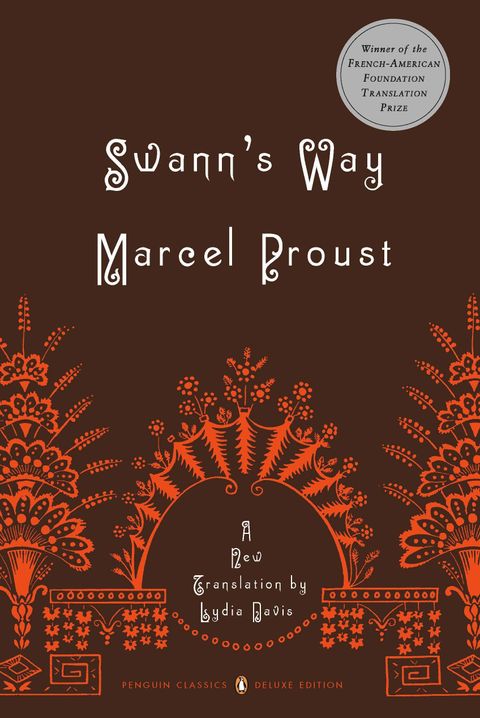
Swann's Way: In Search of Lost Time, Vol. 1
SynopsisPlot
Swann's Way was rejected by a number of publishers, including Fasquelle, Ollendorff, and the Nouvelle Revue Française (NRF). André Gide was famously given the manuscript to read to advise NRF on publication and, leafing through the seemingly endless collection of memories and philosophizing or melancholic episodes, came across a few minor syntactic errors, which made him decide to turn the work down in his audit.
Story
About this book
Swann's Way is the opening volume of Marcel Proust's extended novel In Search of Lost Time, originally published in French as Du côté de chez Swann in 1913. The book follows an unnamed narrator recalling his childhood in the fictional town of Combray, where small sensory details, most famously the taste of a madeleine dipped in tea, trigger vast expansions of memory. Through these recollections, the narrator reconstructs the social world of his family, the landscape of their walks, and the textures of everyday life in late nineteenth-century France.
A large central section shifts focus to Charles Swann, a cultured man from the narrator's parents' circle, and traces his obsessive love for Odette de Crécy. Swann's jealousy, self-deception, and gradual entanglement with Parisian salon society form a sustained study of how desire reshapes perception. Proust builds scenes through long, closely layered sentences that follow the movement of thought rather than the movement of events.
Before publication, the manuscript was turned down by several French publishers, among them Fasquelle, Ollendorff, and the Nouvelle Revue Française. André Gide, advising the NRF on whether to accept it, reportedly skimmed the text, noticed a few minor syntactic errors, and recommended rejection, a decision he later acknowledged as a serious misjudgment.