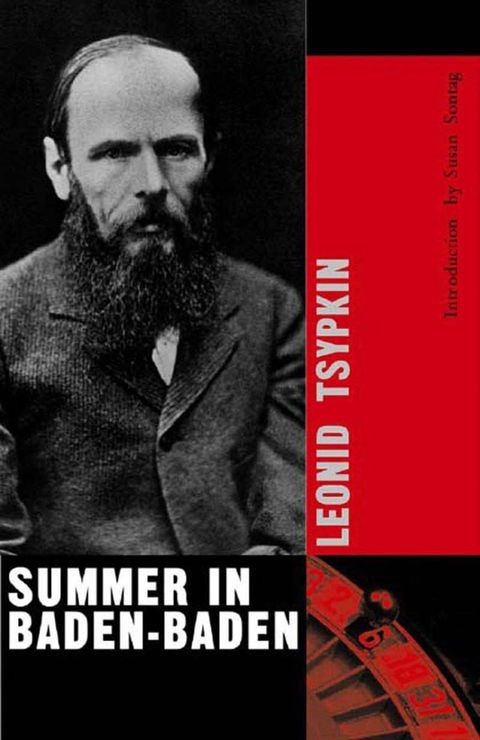
Summer in Baden-Baden
SynopsisPlot
A complex, highly original novel, Summer in Baden-Baden has a double narrative. It is wintertime, late December: a species of "now." A narrator―Tsypkinis on a train going to Leningrad. And it is also mid-April 1867. The newly married Dostoyevskys, Fyodor, and his wife, Anna Grigor'yevna, are on their way to Germany, for a four-year trip. This is not, like J. M. Coetzee's The Master of St. Petersburg, a Dostoyevsky fantasy. Neither is it a docu-novel, although its author was obsessed with getting everything "right." Nothing is invented, everything is invented. Dostoyevsky's reckless passions for gambling, for his literary vocation, for his wife, are matched by her all-forgiving love, which in turn resonates with the love of literature's disciple, Leonid Tsypkin, for Dostoyevsky.
Story
About this book
Summer in Baden-Baden operates on two timelines at once. In one, a narrator identified with the author, Leonid Tsypkin, rides a train toward Leningrad in late December. In the other, it is April 1867, and Fyodor Dostoyevsky and his young wife Anna Grigor'yevna are leaving Russia for Germany, beginning what would become a four-year stay abroad. The two strands run in parallel, braided together through Tsypkin's absorption in the Dostoyevskys' lives.
The 1867 thread follows the couple through the early period of their marriage. Dostoyevsky's compulsive gambling, his fierce dedication to writing, and the strains these place on his relationship with Anna form the core of the narrative. Anna's steadiness and capacity for forgiveness become a counterweight to his turbulence. Tsypkin drew closely on historical sources, particularly Anna Dostoyevsky's own diary and memoirs, aiming for factual accuracy while reshaping the material into something personal and literary.
The book occupies an unusual space between fiction and biographical reconstruction. Tsypkin, a physician and largely unpublished writer during his lifetime, completed it in the early 1980s. The novel's long, flowing sentences carry both timelines forward in a single current, linking the narrator's present-day devotion to Dostoyevsky with the historical scenes he reconstructs.