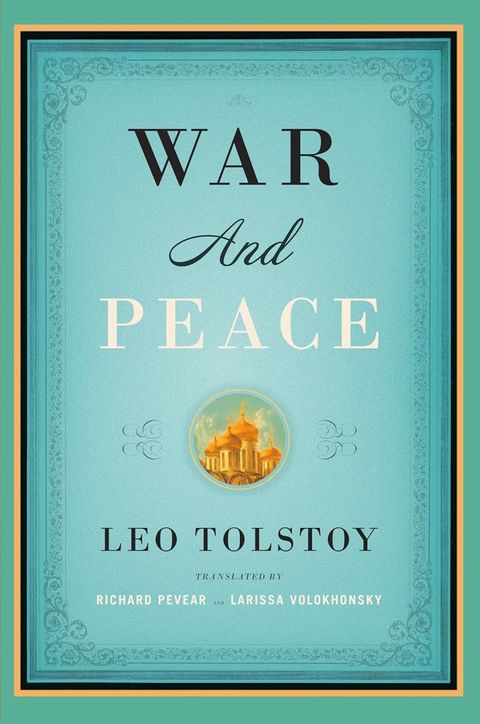
War and Peace
SynopsisPlot
War and Peace centers broadly on Napoleon’s invasion of Russia in 1812 and follows three of the best-known characters in literature: Pierre Bezukhov, the illegitimate son of a count who is fighting for his inheritance and yearning for spiritual fulfillment; Prince Andrei Bolkonsky, who leaves behind his family to fight in the war against Napoleon; and Natasha Rostov, the beautiful young daughter of a nobleman, who intrigues both men. As Napoleon’s army invades, Tolstoy vividly follows characters from diverse backgrounds—peasants and nobility, civilians and soldiers—as they struggle with the problems unique to their era, their history, and their culture. And as the novel progresses, these characters transcend their specificity, becoming some of the most moving—and human—figures in world literature.
Story
About this book
Leo Tolstoy's War and Peace follows five aristocratic Russian families between 1805 and 1813, a period shaped by Napoleon's advance into Russia. The novel opens during the reign of Tsar Alexander I, at a time when the Russian nobility still spoke French as a social requirement, a tradition dating back to Catherine the Great's efforts to align Russia with Western European culture. This linguistic detail runs through the book's drawing rooms and dinner tables, where characters shift between languages depending on audience and occasion.
Three figures anchor the story. Pierre Bezukhov, one of dozens of illegitimate sons of old Count Bezukhov, struggles to claim his inheritance while searching for some larger purpose in life. Prince Andrei Bolkonsky leaves his family at the Bolkonsky estate of Bald Hills to serve in the war. Natasha Rostov, daughter of a warm but financially careless noble household, draws the attention of both men at different points in the narrative.
Around these central lives, Tolstoy places peasants, soldiers, generals, and socialites, tracking how Napoleon's 1812 invasion disrupts every layer of Russian society. The Kuragin family introduces figures of dubious character, while the Drubetskoys represent impoverished nobility trying to regain standing. Tolstoy moves steadily between battlefield and household, treating both with close, specific attention.