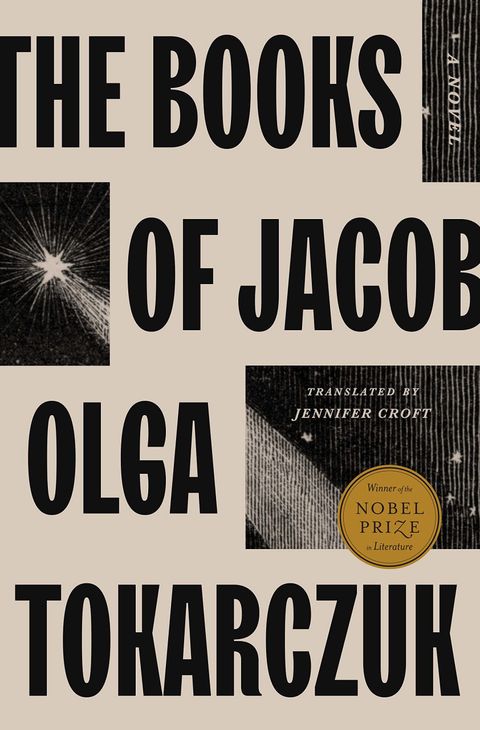
The Books of Jacob
SynopsisPlot
In the mid-eighteenth century, as new ideas—and new unrest—begin to sweep the Continent, a young Jew of mysterious origins arrives in a village in Poland. Before long, he has changed not only his name but his persona; visited by what seem to be ecstatic experiences, Jacob Frank casts a charismatic spell that attracts an increasingly fervent following. In the decade to come, Frank will traverse the Hapsburg and Ottoman empires with throngs of disciples in his thrall as he reinvents himself, again and again, converts to Islam and then Catholicism, is pilloried as a heretic and revered as the Messiah, and wreaks havoc on the conventional order, Jewish and Christian alike, with scandalous rumors of his sect’s secret rituals and the spread of his increasingly iconoclastic beliefs.
Story
About this book
In the mid-eighteenth century, a young man of uncertain origins arrives in a Polish village and begins to gather followers. Known as Jacob Frank, he claims ecstatic visions and reshapes his identity repeatedly, drawing people from Jewish communities across the region into a growing, fervent movement. Olga Tokarczuk builds her novel around this historical figure, tracing his path through the Habsburg and Ottoman empires as he converts first to Islam, then to Catholicism, unsettling religious authorities on every side.
Frank's story sits at the intersection of several forces shaping eighteenth-century Europe: Enlightenment ideas spreading through educated circles, deep tensions within and between religious communities, and the political fragility of the Polish-Lithuanian Commonwealth. Tokarczuk populates the novel with merchants, rabbis, priests, and ordinary believers caught up in Frank's orbit. The narrative moves across borders and languages, reflecting a period when central Europe's cultural map was far more layered than national boundaries suggest.
The book is structured in an unusual way, with sections that move both forward and backward in time. Tokarczuk, who received the Nobel Prize in Literature, wrote it originally in Polish, and the English translation runs well over nine hundred pages.