The Golden Notebook
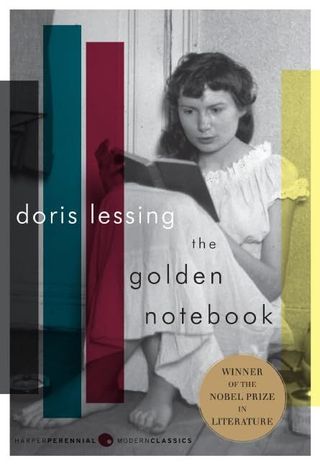
SynopsisPlot
Anna is a writer, author of one very successful novel, who now keeps four notebooks. In one, with a black cover, she reviews the African experience of her earlier years. In a red one she records her political life, her disillusionment with communism. In a yellow one she writes a novel in which the heroine relives part of her own experience. And in a blue one she keeps a personal diary. Finally, in love with an American writer and threatened with insanity, Anna resolves to bring the threads of all four books together in a golden notebook.
Story
About this book
Anna Wulf is a writer living in London, a single mother, and a member of the Communist Party. She has published one successful novel but finds herself unable to write another. Instead, she keeps four separate notebooks, each assigned a different color and a different part of her life. The black notebook covers her years in southern Africa. The red notebook tracks her political activity and growing disillusionment with organized communism. In a yellow notebook she drafts fiction whose heroine closely mirrors her own circumstances. A blue notebook serves as her personal diary.
The novel's structure moves between these four notebooks and a conventional narrative called Free Women, which frames the whole book. Each notebook captures a distinct layer of Anna's experience, and the tensions between them reflect her struggle to hold a coherent sense of self. Political disappointment, creative paralysis, and fractured personal relationships press on her from different directions at once. The prospect of a fifth notebook, the golden one, represents her attempt to reconcile these divided accounts into something whole.
Doris Lessing published the novel in 1962. It became closely associated with the Women's Movement, which recognized its detailed treatment of a woman's inner and outer life during a period of political and personal upheaval.