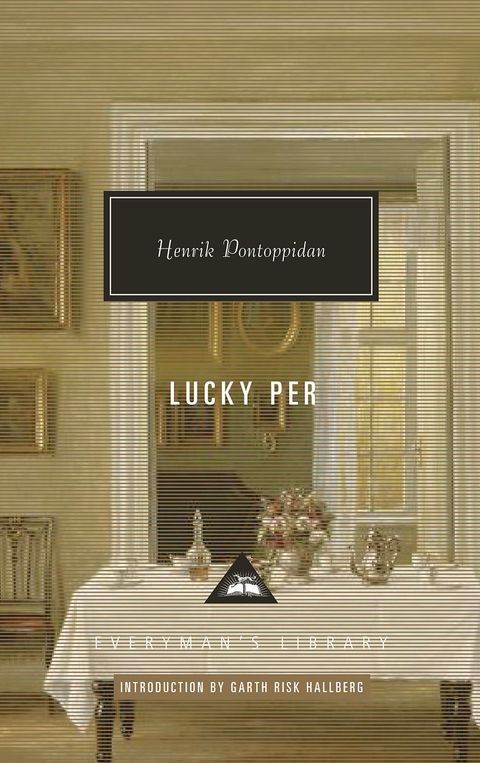
Lucky Per
SynopsisPlot
Lucky Per is a bildungsroman about the ambitious son of a clergyman who rejects his faith and flees his restricted life in the Danish countryside for the capital city. Per is a gifted young man who arrives in Copenhagen believing that "you had to hunt down luck as if it were a wild creature, a crooked-fanged beast . . . and capture and bind it." Per's love interest, a Jewish heiress, is both the strongest character in the book and one of the greatest Jewish heroines of European literature.
Story
About this book
Lucky Per, first published in 1898-1904, is a bildungsroman by Danish author Henrik Pontoppidan, who shared the Nobel Prize in Literature in 1917. The novel follows Per, the son of a provincial clergyman, who breaks away from his family's strict religious world and moves to Copenhagen. He arrives in the capital full of ambition, convinced that fortune is something to be chased down and seized by force. His plans are grand, his confidence is high, and his sense of his own abilities is firm.
In Copenhagen, Per enters a wider social world that includes Jakobe, a Jewish heiress who becomes his love interest. The teaser material describes her as the strongest character in the book and one of the notable Jewish heroines in European fiction. Through Per's encounters with wealth, intellectual circles, love, and his own upbringing, the novel tracks the distance between what a person wants and what a person is able to become. Questions of faith, class, cultural identity, and self-knowledge run through the story without arriving at simple answers.
Pontoppidan wrote the novel across several years, and it appeared in eight parts before being collected as a single work. It has been called the great Danish novel, though it remained little known outside Scandinavia for much of the twentieth century.