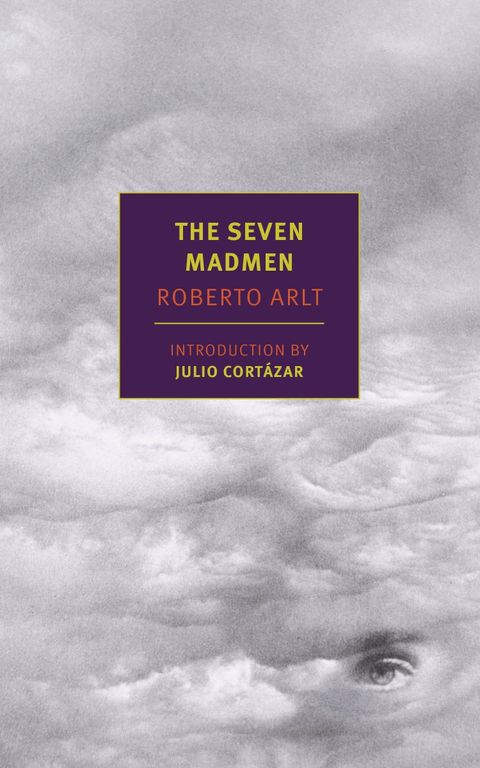
The Seven Madmen
SynopsisPlot
A weird wonder of Argentine and modern literature and a crucial work for Julio Cortázar, The Seven Madmen begins when its hapless and hopeless hero, Erdosain, is dismissed from his job as a bill collector for embezzlement. Then his wife leaves him and things only go downhill after that. Erdosain wanders the crowded, confusing streets of Buenos Aires, thronging with immigrants almost as displaced and alienated as he is, and finds himself among a group of conspirators who are in thrall to a man known simply as the Astrologer. The Astrologer has the cure for everything that ails civilization. Unemployment will be cured by mass enslavement. (Mountains will be hollowed out and turned into factories.) Mass enslavement will be funded by industrial-scale prostitution. That scheme will be kicked off with murder. “D’you know you look like Lenin?” Erdosain asks the Astrologer. Meanwhile, Erdosain struggles to determine the physical location and dimensions of the soul, this thing that is causing him so much pain.
Story
About this book
The Seven Madmen follows Erdosain, a bill collector in Buenos Aires who loses his job after being caught embezzling. Shortly after, his wife leaves him. With little left to hold him in place, Erdosain drifts through the city's crowded streets, surrounded by immigrants who seem nearly as rootless as he is. He eventually falls in with a circle of conspirators led by a figure known only as the Astrologer, a man with grand and disturbing plans for remaking society.
The Astrologer's vision is both absurd and sinister. He proposes to eliminate unemployment through forced labor on an enormous scale, with factories built inside hollowed-out mountains. This operation would be financed through organized prostitution and set into motion with murder. Erdosain, meanwhile, is preoccupied with a different kind of problem: he wants to determine the physical location and dimensions of the human soul, the source of his persistent anguish.
Roberto Arlt published the novel in 1929 in Argentina. The book draws comparisons to Dostoyevsky for its intense psychological atmosphere and its cast of desperate, idea-obsessed characters. It has been cited as an important influence on later Argentine writers, including Julio Cortazar.