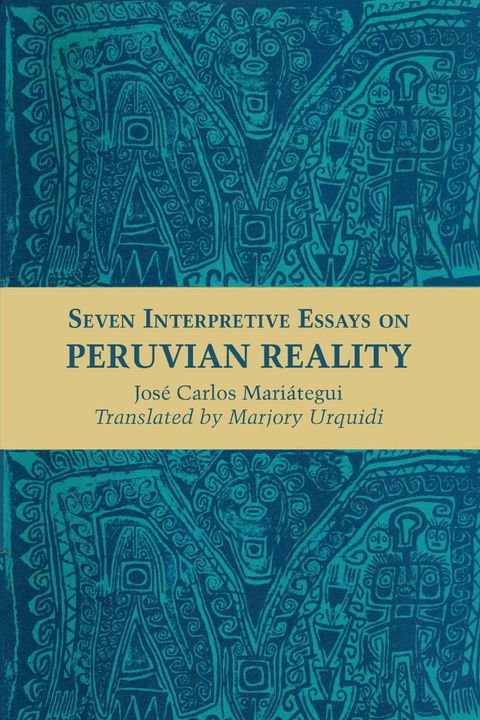
Seven Interpretive Essays on Peruvian Reality
SynopsisPlot
Seven Interpretive Essays on Peruvian Reality (Siete ensayos de interpretación de la realidad peruana), first published in 1928, is Mariátegui's major statement of his position and has gone into many editions, not only in Peru but also in other Latin American countries. The topics discussed in the essays—economic evolution, the problem of the Indian, the land problem, public education, the religious factor, regionalism and centralism, and the literary process—are in many respects as relevant today as when the book was written.
Story
About this book
José Carlos Mariátegui, born in Peru in 1894, was among the most influential social thinkers in early twentieth-century South America. His Seven Interpretive Essays on Peruvian Reality, first published in Spanish in 1928 as Siete ensayos de interpretación de la realidad peruana, stands as his central intellectual work. The book has been reprinted many times in Peru and across Latin America.
The seven essays each take up a distinct dimension of Peruvian society. Mariátegui examines the country's economic development, the situation and treatment of Indigenous peoples, land ownership and distribution, the state of public education, the role of religion, the tension between regionalism and centralism, and Peru's literary culture. Rather than treating these subjects in isolation, Mariátegui connects them to broader structures of class, colonial inheritance, and political power.
Mariátegui wrote from a Marxist perspective, applying materialist analysis to conditions specific to Peru rather than importing European frameworks without adaptation. His attention to Indigenous communities and to land as a political question gave the essays a focus that distinguished them from much European-oriented social theory of the period. The book has served as a reference point for historians, political scientists, sociologists, and anthropologists studying Peru.