On the Heights of Despair
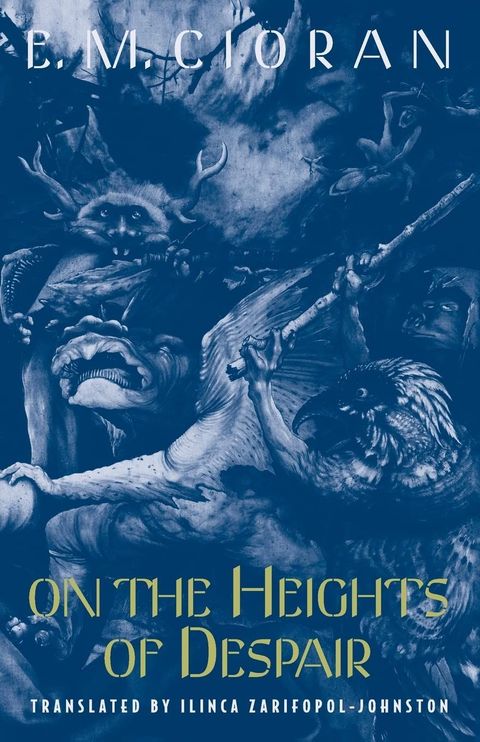
SynopsisPlot
Born of a terrible insomnia—"a dizzying lucidity which would turn even paradise into hell"—this book presents the youthful Cioran, a self-described "Nietzsche still complete with his Zarathustra, his poses, his mystical clown's tricks, a whole circus of the heights." It also presents Cioran as a connoisseur of apocalypse, a theoretician of despair, for whom writing and philosophy both share the "lyrical virtues" that alone lead to a metaphysical revelation.
Story
About this book
E. M. Cioran wrote On the Heights of Despair in Romania in 1934, when he was twenty-two years old. The book grew out of a period of severe insomnia that Cioran later described as a state of unbearable clarity. In short, aphoristic chapters he confronts despair, death, madness, and the absurdity of being conscious at all. Rather than building systematic arguments, Cioran writes in an intensely personal and lyrical style, treating philosophy and physical suffering as closely linked experiences.
Cioran later recalled that writing this book kept him alive, calling it a substitute for and an antidote to self-destruction. He saw himself at the time as a young imitator of Nietzsche, full of dramatic poses and theatrical intensity. The text circles around the irrationality of existence, the sensation of decay, and the feeling of alienation from any stable meaning. Yet running alongside the anguish is a thread of dark, self-aware humor that prevents the work from collapsing into pure bleakness.
The themes Cioran raises here, including futility, absurdity, and the limits of reason, would recur throughout his later career. He eventually moved from Romanian to French and became known for a spare, polished prose style. This early work shows the raw starting point of that long development.