The Hitchhiker's Guide to the Galaxy
SynopsisPlot
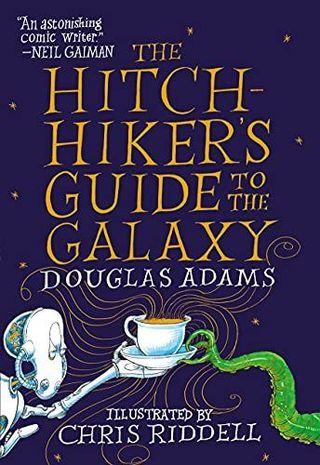
This beautifully illustrated edition of the New York Times bestselling classic celebrates the 42nd anniversary of the original publication Plot: It’s an ordinary Thursday morning for Arthur Dent . . . until his house gets demolished. The Earth follows shortly after to make way for a new hyperspace express route, and Arthur’s best friend has just announced that he’s an alien. After that, things get much, much worse. With just a towel, a small yellow fish, and a book, Arthur has to navigate through a very hostile universe in the company of a gang of unreliable aliens. Luckily the fish is quite good at languages. And the book is The Hitchhiker’s Guide to the Galaxy . . . which helpfully has the words DON’T PANIC inscribed in large, friendly letters on its cover. Douglas Adams’s mega-selling pop-culture classic sends logic into orbit, plays havoc with both time and physics, offers up pithy commentary on such things as ballpoint pens, potted plants, and digital watches . . . and, most important, reveals the ultimate answer to life, the universe, and everything. Now, if you could only figure out the question. . . .
Story
About this book
Arthur Dent's Thursday begins with the demolition of his house and worsens when Earth itself is destroyed to clear room for a hyperspace express route. His best friend turns out to be an alien. Armed with a towel, a small yellow fish that handles translation, and a copy of a fictional encyclopaedia called The Hitchhiker's Guide to the Galaxy, Arthur travels with a group of unreliable aliens.
Douglas Adams first wrote the story as a BBC radio series, then adapted the opening parts into this novel. It was published in London on 12 October 1979, and a quarter of a million copies sold within three months. The book began a series Adams called a trilogy in five parts, which eventually reached six volumes. The Guide the characters carry was modelled on a real travel handbook, the Hitch-hiker's Guide to Europe.
The novel treats large-scale destruction, bureaucracy, and cosmic indifference as material for comedy rather than drama. Adams built jokes around everyday objects such as digital watches, ballpoint pens, and potted plants, then set them against interstellar travel and planetary engineering. The Guide's cover carries the words DON'T PANIC in large, friendly letters. It also promises an ultimate answer to life, the universe and everything, though the matching question stays elusive.