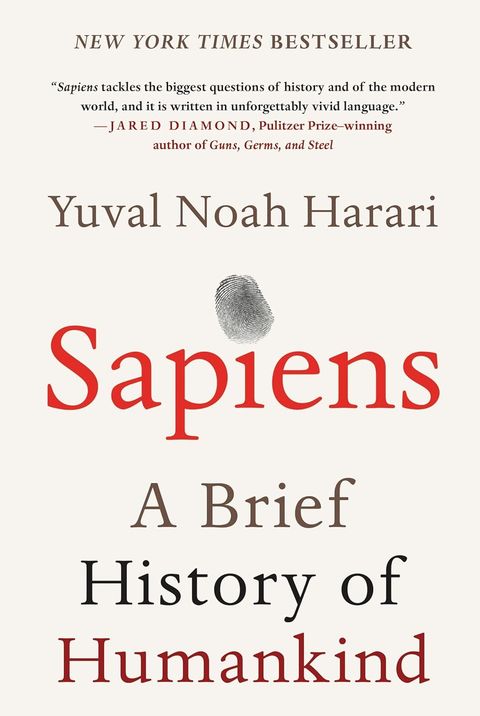
Sapiens: A Brief History of Humankind
SynopsisPlot
One hundred thousand years ago, at least six different species of humans inhabited Earth. Yet today there is only one—homo sapiens. What happened to the others? And what may happen to us? Most books about the history of humanity pursue either a historical or a biological approach, but Dr. Yuval Noah Harari breaks the mold with this highly original book that begins about 70,000 years ago with the appearance of modern cognition. From examining the role evolving humans have played in the global ecosystem to charting the rise of empires, Sapiens integrates history and science to reconsider accepted narratives, connect past developments with contemporary concerns, and examine specific events within the context of larger ideas.
Story
About this book
Around 100,000 years ago, several distinct human species shared the planet. Homo sapiens was only one of them. Yuval Noah Harari, an Israeli historian, opens with this fact and traces how our species came to be the sole survivor. The book picks up roughly 70,000 years ago, at the point when modern cognitive abilities appear in the archaeological record, and follows the course of human development from there through the Agricultural Revolution, the spread of empires, and the rise of global networks of trade and belief.
Harari works across disciplinary lines, drawing on biology, anthropology, economics, and recorded history to examine how humans organized themselves into ever-larger groups. A central argument is that Homo sapiens succeeded in part because of a shared capacity for collective fiction: money, laws, religions, and nations are all, in his framing, stories that large numbers of people agree to treat as real. The book also addresses how humans have reshaped other species and entire ecosystems over millennia.
In its later sections, the book turns toward recent decades, noting that humans have begun to alter the biological rules that governed life for roughly four billion years. Harari raises questions about genetic engineering and other technologies without settling on a single prediction for what comes next.