History of the World Map by Map
SynopsisPlot
Maps don't just show us where to go, but also where we've been. If you're interested in finding out more about the biggest events in world history, then this book all about history of the world is perfect for you! This stunning history book for adults starts with the evolution and migration of our oldest ancestors out of Africa. You can then look up maps about the Greece and Persian War, the Mongol Conquests, Medieval Europe's trade routes, and the rise of the Ottomans. Explore maps about the colonisation of North America, the scientific revolution, Napoleon's advances, and Britain's control of India. Then uncover the history of later centuries, such as the Age of Imperialism, the American Civil War, industrialised Europe and the transformation of Japan.
Story
About this book
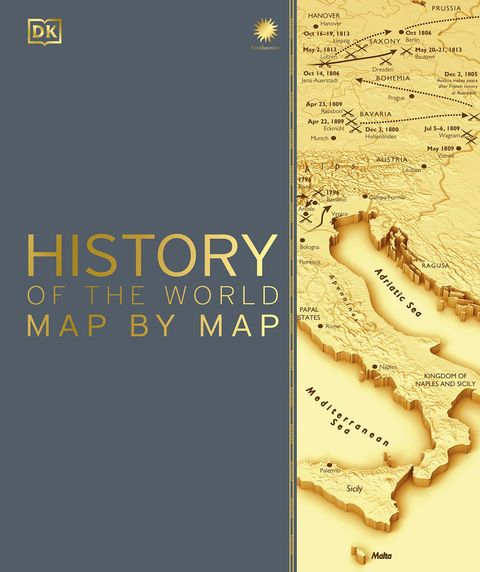
History of the World Map by Map is a large-format reference book produced by DK in collaboration with the Smithsonian Institution. It presents major events and periods in human history through detailed maps, timelines, and supporting graphics. The book opens with early human migration out of Africa and moves forward through millennia, covering conflicts such as the wars between Greece and Persia, the Mongol conquests, and the American Civil War, alongside broader patterns like medieval European trade routes and the scientific revolution.
Each section pairs cartographic visuals with explanatory text, so a reader can see where an event unfolded and follow its geographic reach. Topics range across every inhabited continent: the rise of the Ottoman Empire, the colonization of North America, Napoleon's campaigns in Europe, British rule in India, the industrialization of European economies, and the political transformation of Japan in the nineteenth century. The scope is global rather than centered on a single tradition or region.
The book is organized chronologically, which lets patterns of expansion, contact, and change accumulate as pages turn. Its maps serve as spatial indexes to periods that are often taught through names and dates alone, offering a geographic dimension to each subject.