Divine Punishment
SynopsisPlot
In this, the greatest work of a storied literary career, Sergio Ramírez transforms the most celebrated criminal trial in Nicaraguan history the alleged murders in 1933 of two high society women and his employer by a social-climbing bon vivant named Oliverio Castañeda into an examination of the entire Nicaraguan society at the brink of the first Somosa dictatorship. Passion, money, sex, gossip, political intrigue, medical malpractice, and judicial corruption all merge into a novel that reads like a courtroom drama wrapped in yellow journalism disguised as historical fiction posing as a scandal of the first order.
Story
About this book
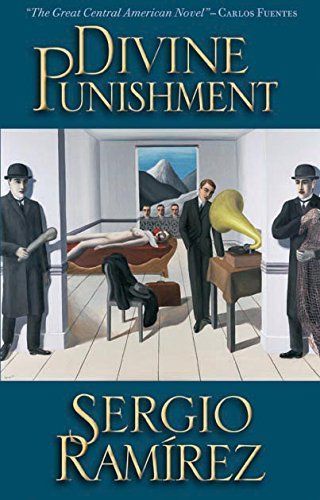
Divine Punishment is a novel by Sergio Ramirez built around a real criminal case from 1933 Nicaragua. At its center is Oliverio Castaneda, a socially ambitious young man accused of poisoning two wealthy women and his own employer in the city of Leon. The trial became one of the most talked-about events in Nicaraguan history, and Ramirez uses it as a lens to examine the society that produced it.
The novel layers courtroom proceedings, newspaper coverage, gossip, love affairs, and political maneuvering into a single tangled narrative. Medical testimony, judicial corruption, and class resentment all figure in the story, which unfolds against the backdrop of Nicaragua on the edge of the first Somoza dictatorship. Ramirez reconstructs not only the facts of the case but the atmosphere of a small, tightly connected society where private scandal and public power are difficult to separate.
Carlos Fuentes called Divine Punishment the quintessential Central American novel. Ramirez, who later served as vice president of Nicaragua, draws on historical documents and local memory to populate the book with voices from journalists, witnesses, lawyers, and bystanders, giving the story the texture of a city arguing with itself over what really happened.