SynopsisPlot
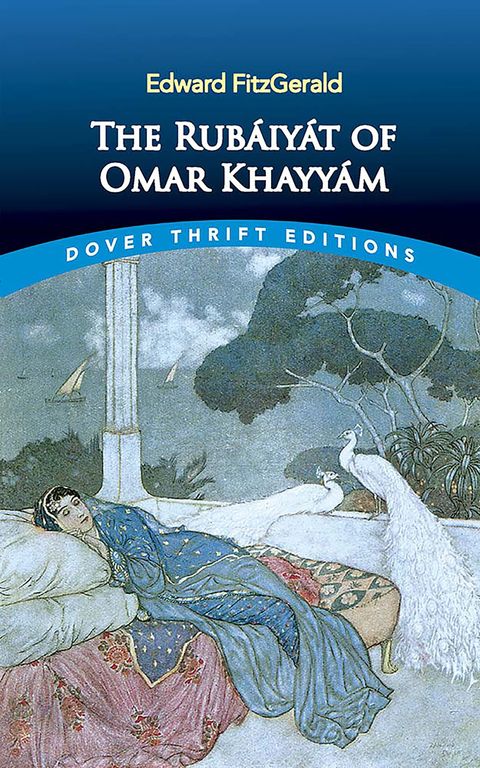
Omar Khayyám (1048–1122) was a Persian mathematician, astronomer, and philosopher who was not known as a poet in his lifetime. Later, a body of quatrains became attached to his name, although not all were his works. These verses lay in obscurity until 1859, when Edward FitzGerald (1809–1883), an English country gentleman, published a free adaptation of this Persian poetry. After its discovery by D. G. Rossetti and others, the verse became extremely popular. Essentially a hedonist and a skeptic, Omar Khayyám, through FitzGerald, spoke with both an earthy and spiritual freedom that stirred a universal response. As a result, the Rubáiyát became one of the best-known and most often quoted English classics.
Story
About this book
Omar Khayyam (1048-1122) was a Persian polymath based in Nishapur and later Isfahan, known during his lifetime for his contributions to mathematics and astronomy rather than poetry. He helped reform the Persian calendar and wrote influential work on algebra. A collection of short four-line poems, or quatrains, became associated with his name over the centuries, though scholars continue to debate how many he actually composed. The verses address mortality, pleasure, doubt, the passing of time, and the limits of human knowledge.
In 1859, the English writer Edward FitzGerald published a loose English adaptation of these Persian quatrains. The translation was not a strict word-for-word rendering but a creative reshaping of the originals into flowing English verse. Initially the publication attracted little attention. After the poet and painter Dante Gabriel Rossetti and others encountered it, interest grew steadily, and FitzGerald's version eventually became one of the most widely quoted works in the English language.
The result is a text with two layers of authorship: the medieval Persian originals and FitzGerald's nineteenth-century English voice. The quatrains move between skepticism toward certainty and open enjoyment of earthly life, giving the collection a tone that has appealed to readers across very different cultures and periods.