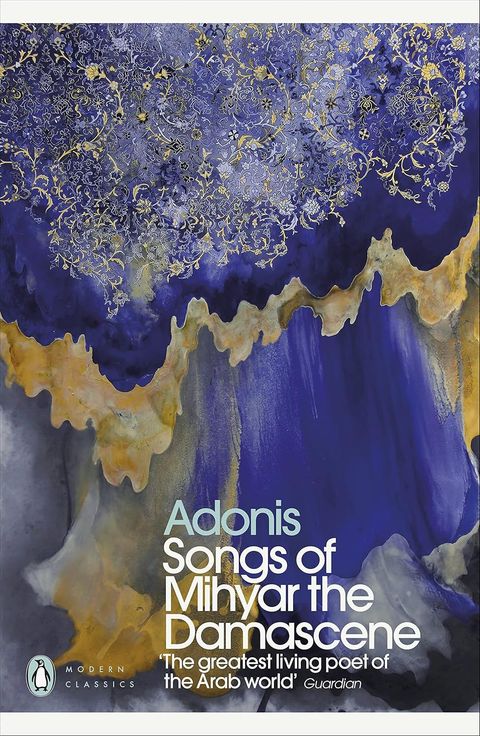
Songs of Mihyar the Damascene
SynopsisPlot
Cloud, mirror, stone, thunder, eyelid, desert, sea. Through a dead or dying land, Mihyar walks: a figure of heroic individualism and dissent, part-Orpheus, part-Zarathustra. Where he goes, the austere building-blocks of his world become the expressions of passionate emotion, of visionary exaltation and despairing melancholy. The traditions of the Ancient Greeks, the Bible and the Quran flow about and through him. These are poems against authoritarianism and dogma, in which a new Noah would abandon his ark to dive with the condemned, and in which surrealism and Sufi mysticism meet and intertwine. The result is a masterpiece of world literature.
Story
About this book
Songs of Mihyar the Damascene is a poetry collection by the Syrian-born poet Adonis, written in Beirut in the early 1960s. Its central figure, Mihyar, moves through a landscape that feels both ancient and barren, encountering elemental images such as cloud, stone, desert, and sea. He is drawn partly from the tradition of Orpheus and partly from Nietzsche's Zarathustra, a solitary walker whose presence transforms the sparse features of his surroundings into expressions of intense feeling, ranging from exaltation to grief.
The poems challenge authoritarianism and rigid doctrine. Biblical, Quranic, and Ancient Greek references run through the text, and the collection brings together surrealist technique with elements of Sufi mystical tradition. In one passage, a reimagined Noah chooses to abandon his ark and descend with those who have been condemned rather than sail above them. These inversions of familiar stories give the poems a persistent sense of defiance.
Adonis, born Ali Ahmad Said Esber in Syria, settled in Lebanon and became one of the most prominent Arabic-language poets of the twentieth century. The collection has been compared in its impact on Arabic poetry to the effect T.S. Eliot's The Waste Land had on English-language verse. This English-language edition makes the work accessible to readers outside the Arabic literary world.