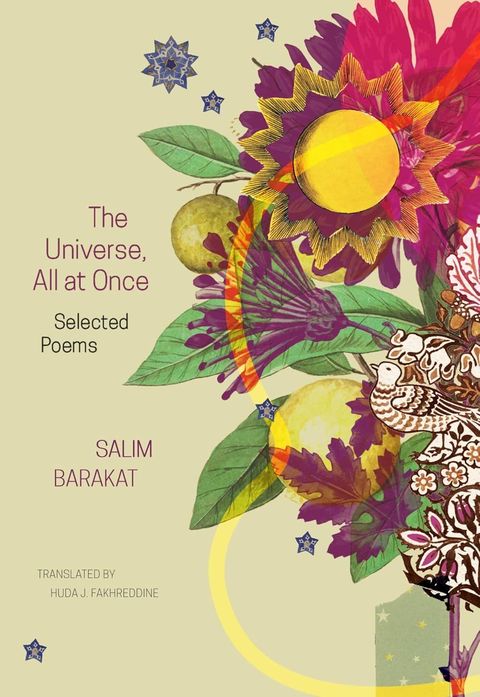
The Universe, All at Once
SynopsisPlot
Salim Barakat, the captivating Kurdish-Syrian poet and novelist known for his mastery of Arabic style, is hailed as an enigmatic and intricate figure in contemporary Arabic literature. In The Universe, All at Once, he curates, in collaboration with translator Huda J. Fakhreddine, a selection from his later works, considering them the pinnacle of his poetic career. Drawn from pieces composed between 2021 and 2023, the poems in this collection vary from excerpts of an expansive book-length poem to concise, intense fragments. Fakhreddine expertly renders his writing in English, a courageous and praiseworthy attempt to challenge the barriers of the untranslatable.
Story
About this book
Salim Barakat is a Kurdish-Syrian poet and novelist who writes in Arabic and is widely regarded as one of the most distinctive voices in contemporary Arabic literature. Born in Qamishli, a city in northeastern Syria near the Turkish border, Barakat has spent much of his life outside his homeland. His writing in Arabic carries a layered complexity that has earned him a reputation as one of the language's most challenging and original stylists.
The Universe, All at Once gathers poems from his later work, composed between 2021 and 2023. Barakat selected these pieces himself, in collaboration with translator Huda J. Fakhreddine, who rendered them into English. The collection ranges from sections of a longer, book-length poem to shorter, compressed fragments. Each piece reflects a writer working at the far edges of what Arabic poetic language can hold, and the translation confronts the difficulty of carrying that density across into English.
Barakat's poetry does not follow familiar patterns of accessibility. The language is dense and often resistant to easy summary, shaped by a sensibility that draws on both Kurdish cultural memory and the possibilities of Arabic as a literary instrument. This bilingual tension runs through the collection as a steady undercurrent.