The Good Soldier Svejk
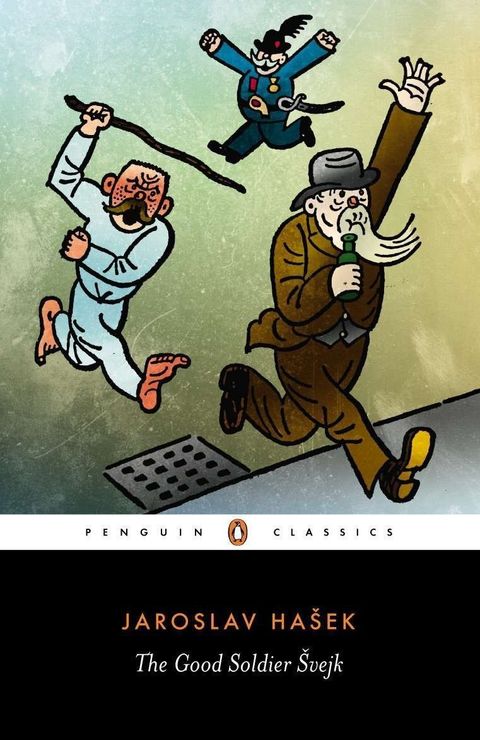
SynopsisPlot
Good-natured and garrulous, Švejk becomes the Austro-Hungarian army's most loyal Czech soldier when he is called up on the outbreak of the First World War - although his bumbling attempts to get to the front serve only to prevent him from reaching it. Playing cards, getting drunk, and becoming a general nuisance, the resourceful Švejk uses all his natural cunning and genial subterfuge to deal with the doctors, police, clergy, and officers who chivvy him towards the battle.
Story
About this book
Jaroslav Hasek's unfinished novel, published between 1921 and 1923, follows Josef Svejk, a good-humored, middle-aged Czech man called up to serve in the Austro-Hungarian army at the start of the First World War. Svejk declares himself an enthusiastic soldier, yet his repeated attempts to reach the front line never quite succeed. Whether through genuine incompetence or quiet cunning, he drifts from one absurd situation to the next, tangling with military doctors, police officers, chaplains, and commanding officers along the way.
The full Czech title translates roughly as The Fateful Adventures of the Good Soldier Svejk During the World War, and the book is structured as a loose chain of episodes rather than a tightly plotted narrative. Svejk plays cards, drinks, tells long-winded stories, and generally makes himself a nuisance, all while maintaining an air of cheerful obedience. The satire works by placing one apparently simple man against a sprawling military bureaucracy that proves no more rational than he is.
The novel has been translated into more than fifty languages, making it the most widely translated work of Czech literature. Hasek died in 1923 before completing it, so the story breaks off without a formal conclusion.