The Decameron
SynopsisPlot
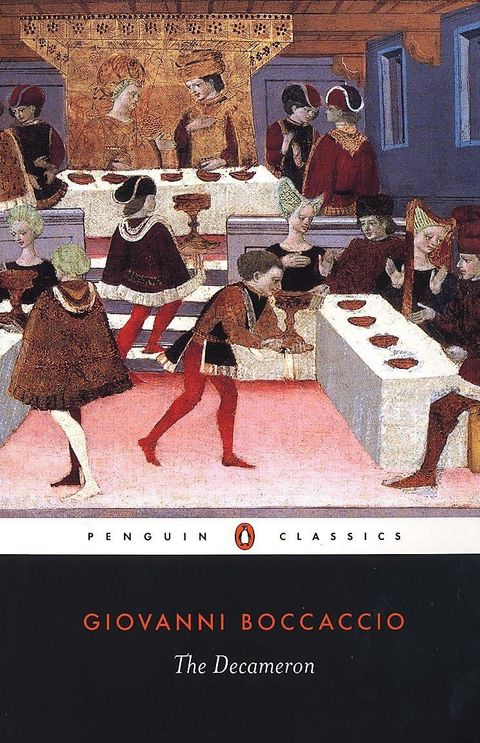
In the summer of 1348, as the Black Death ravages their city, ten young Florentines take refuge in the countryside. They amuse themselves by each telling a story a day for the ten days they are destined to remain there—a hundred stories of love, adventure and surprising twists of fate. Less preoccupied with abstract concepts of morality or religion than with earthly values, the tales range from the bawdy Peronella hiding her lover in a tub to Ser Cepperello, who, despite his unholy effrontery, becomes a Saint. The result is a towering monument of European literature and a masterpiece of imaginative narrative.
Story
About this book
In 1348 the Black Death reached Florence. Giovanni Boccaccio, writing probably between 1349 and 1353, used that catastrophe as the frame for a work of fiction. Ten young people, seven women and three men, leave the stricken city for a villa in the hills near Fiesole. Each tells one story a day across ten days, producing one hundred tales. The title reflects that structure: Decameron means roughly ten days of work.
The stories range widely in subject and tone. Some are comic and sexually frank, such as the tale of Peronella hiding her lover inside a tub. Others follow tricksters, merchants, lovers and clergy through situations that test wit, loyalty and luck. One concerns Ser Cepperello, whose brazen dishonesty leads toward veneration as a saint. Rather than dwelling on moral or religious abstractions, the collection attends to human resourcefulness and the workings of fortune.
Each day has a chosen leader who sets the theme for that day's tales. The remaining days of the group's fortnight are set aside for rest or devotion. Every day closes with a canzone, a sung poem, and some of these count among Boccaccio's finest verse. It has long been counted among the masterpieces of classical Italian prose.