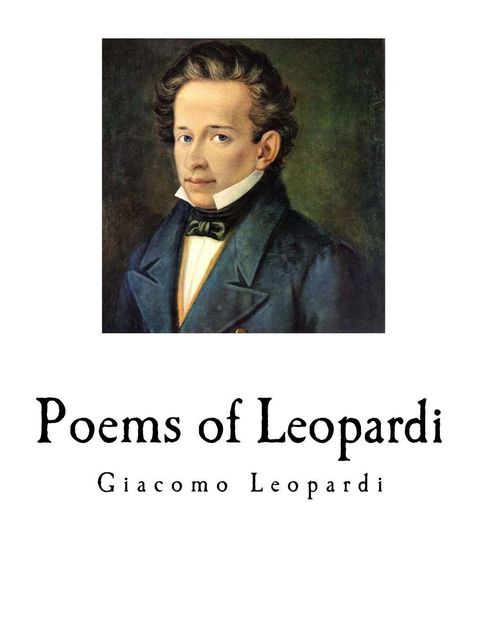
Poems of Leopardi
SynopsisPlot
Giacomo Leopardi was born at Recanati, a town of the March of Ancona, on the twenty-ninth of June, 1798; the eldest son of Count Monaldo Leopardi, and Adelaide, his wife, daughter of the Marquis Antici. He had four brothers and one sister—Paolina. His father possessed a splendid library, and was a man of learning and literary tastes, appearing himself as an author in prose and verse. Recanati is situated on an eminence in the Appenines, not far from Ancona and the celebrated shrine of Loreto; and as a biographer of our poet says: "Its natural beauties are superb, and the genius of its great son has made them incomparable." Up to the age of twenty-four Leopardi did not leave his native place. The constant sight of so lovely a landscape, bordered in the distance by the Adriatic, contributed in no slight measure to give him that exquisite taste and sympathy for nature, for which he is unique among the poets of his country.
Story
About this book
Giacomo Leopardi was born on 29 June 1798 in Recanati, a hilltop town in the Marche region of central Italy, near Ancona and the Adriatic coast. He was the eldest son of Count Monaldo Leopardi, who maintained a large private library and had his own literary ambitions. Leopardi grew up surrounded by books and by the landscape visible from Recanati's elevated position in the Apennines, with views stretching to the sea. He did not leave his hometown until the age of twenty-four, and those years of close observation shaped a distinctive sensitivity to the natural world.
This collection gathers poems from a writer widely regarded as the foremost Italian poet of the nineteenth century. Leopardi's verse returns often to questions of nature, beauty, and the limits of human experience. His language is precise and controlled, grounded in the specific terrain he knew from childhood. The hills, light, and distances around Recanati appear throughout his work, not as decoration but as a way of thinking about what it means to perceive and to feel.
Leopardi also produced significant prose and philosophical writing during his short life. He died in 1837 at the age of thirty-eight. His poetry remains central to Italian literary tradition and continues to be translated into many languages.