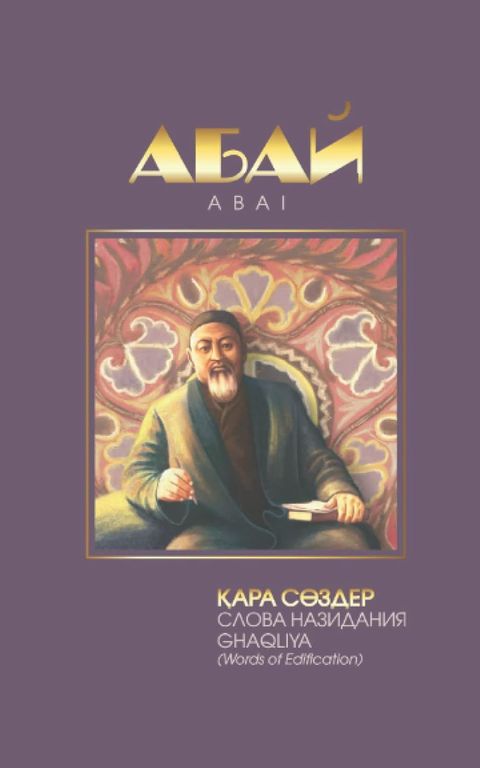
Words of Edification
SynopsisPlot
“If one is to speak about them as a whole, the legacy of Abai’s, so-translated Ghaqliya “Words of Edification”, differ from literary prose and most likely deserve to be recognized as a unique genre in their own right. These are works that have no narrative and if we are talking about their style and content then this is an aesthetic form that Abai discovered himself, a unique and special form of the artistic word. Sometimes, they resemble philosophical reflections or critical exhortations but more often they are edifying teachings, deep thoughts devoted to moral, ethical problems.”
Story
About this book
Abay Kunanbayuly, widely regarded as the founder of modern Kazakh written literature, composed Words of Edification as a series of 45 short prose pieces during the 1890s. Each piece addresses a different aspect of personal conduct, social responsibility, or the pursuit of knowledge. The writings do not follow a narrative arc. Instead, they function as self-contained reflections on questions of ethics, education, and what it means to live with purpose in a changing society.
The form Abay chose for these pieces sits outside conventional literary categories. Some entries read as philosophical argument, others as moral instruction or sharp social criticism directed at habits he saw weakening Kazakh communal life. A recurring concern is the value of learning, both from one's own traditions and from the wider world. Abay urges discipline, honesty, and careful thought over passivity and imitation. His tone shifts between patient teaching and pointed challenge, depending on the subject.
Born in 1845 in what is now the Semey region of northeastern Kazakhstan, Abay wrote in Kazakh at a time when most formal literary production in Central Asia used other languages. Words of Edification remains one of the central texts studied across Kazakhstan today.