Dictionary of the Khazars
SynopsisPlot
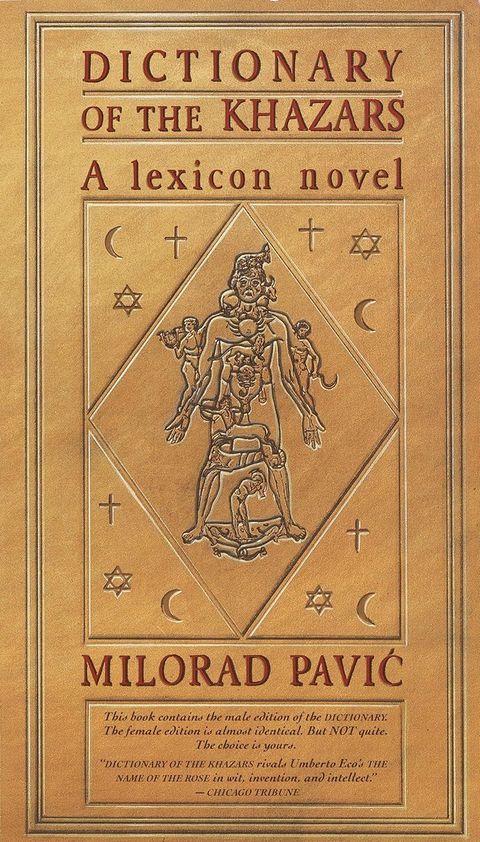
Written in two versions, male and female (both available in Vintage International), which are identical save for seventeen crucial lines, Dictionary is the imaginary book of knowledge of the Khazars, a people who flourished somewhere beyond Transylvania between the seventh and ninth centuries. Eschewing conventional narrative and plot, this lexicon novel combines the dictionaries of the world's three major religions with entries that leap between past and future, featuring three unruly wise men, a book printed in poison ink, suicide by mirrors, a chimerical princess, a sect of priests who can infiltrate one's dreams, romances between the living and the dead, and much more.
Story
About this book
Dictionary of the Khazars by Milorad Pavic takes the form of an encyclopedia rather than a conventional novel. It gathers entries about the Khazars, a real people who held power in the region beyond Transylvania roughly between the seventh and ninth centuries. The book is organized into three smaller dictionaries, each reflecting the perspective of one of the three major monotheistic religions. Entries move freely between historical periods, and readers can approach them in almost any order.
The novel was published in two separate editions, labeled male and female. The two versions are nearly identical, differing by only seventeen lines. Within its entries, the book presents three scholars whose work intersects across centuries, a princess of uncertain origin, a religious sect capable of entering dreams, a book whose pages are printed in poisonous ink, and relationships that cross the boundary between the living and the dead. Pavic, a Serbian writer, structured the work so that each reading path through the entries can produce a slightly different experience of the story.
The book became a national bestseller and was named by The New York Times Book Review as one of the best books of its year. Pavic's approach treats the encyclopedia format itself as a storytelling device, letting fragments of myth, theology, and historical speculation accumulate across its pages.