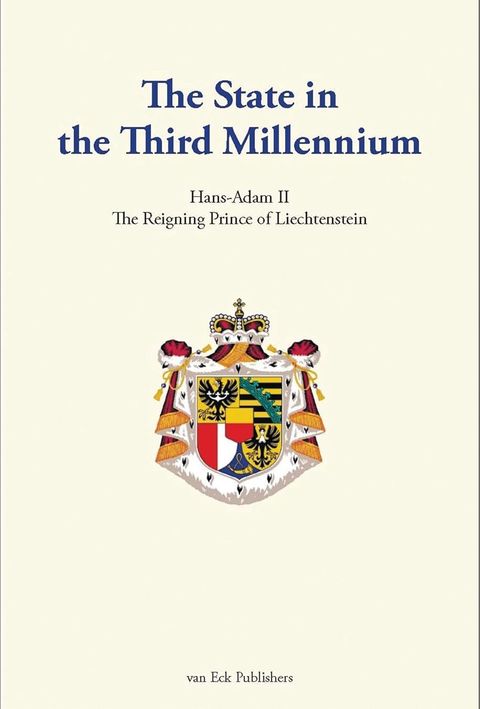
The State in the Third Millennium
SynopsisPlot
Prince Hans-Adam of Liechtenstein is able to look at the modern nation-state from many different angles: as a head of state; as a politician, who had to win popular votes in a direct democracy; as a businessman active in different continents; and as an historian who has studied the influence of military technology, transportation and the economy on the workings of the state.
Story
About this book
The State in the Third Millennium is a political essay by Prince Hans-Adam II of Liechtenstein, examining how the modern nation-state developed and where it might be headed. The author draws on his unusual combination of roles: reigning monarch of a small European state, participant in Liechtenstein's system of direct democracy, and internationally active businessman. His argument considers how shifts in military technology, transportation, and economics have historically reshaped the structure of states, and asks which of those forces are likely to matter most in the decades ahead.
Liechtenstein itself serves as a quiet reference point throughout. With roughly 160 square kilometres of territory between Switzerland and Austria, it is one of the smallest sovereign states in the world, yet it operates with a high degree of self-determination and a distinctive constitutional arrangement that blends monarchy with direct popular votes. The book uses this small-state perspective to question assumptions that large centralized governments are the only workable model. Hans-Adam proposes that future states could function more effectively by granting communities greater autonomy, including, in his framework, the theoretical right of local populations to separate peacefully from the states they belong to.