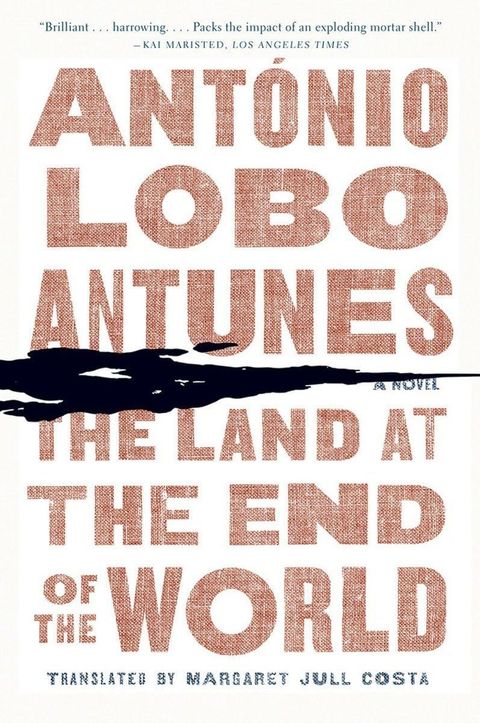
The Land at the End of the World
SynopsisPlot
In the tradition of William Faulkner and Gabriel García Márquez, one of the twentieth century’s most original literary voices offers "kaleidoscopic visions of a modern Portugal scarred by its Fascist past and its bloody colonial wars in Africa" (Paris Review). Hailed as a masterpiece of world literature, The Land at the End of the World―in an acclaimed translation by Margaret Jull Costa―recounts the anguished tale of a Portuguese medic haunted by memories of war. Like the Ancient Mariner who will tell his tale to anyone who listens, the narrator’s evening unfolds like a fever dream that is both tragic and haunting. The result is one of the great war novels of the modern age.
Story
About this book
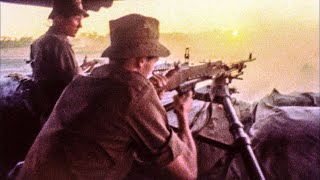
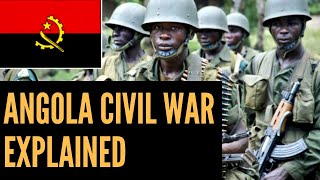
The Land at the End of the World is a novel by António Lobo Antunes, one of Portugal's most prominent literary figures. Set against the backdrop of the Portuguese colonial war in Angola in the early 1970s, the book takes the form of a long monologue delivered by a former military doctor to an unnamed woman during a night of drinking. He recounts his time as a medic in the conflict, and the physical and psychological destruction it left behind.
The narrative unfolds with the feverish quality of a confession that cannot be stopped once started. The narrator, now back in Portugal, circles through memories of Angola, of the violence he witnessed, and of a country and a self he can no longer recognize. Lobo Antunes draws on his own experience as a doctor deployed to Angola during the war, and the novel carries a sharp sense of firsthand observation. The English translation is by Margaret Jull Costa.
Rather than following a conventional plot, the book builds its force through accumulation, returning again and again to images of landscape, decay, and disillusionment. The structure has been compared to the compulsive storytelling of Coleridge's Ancient Mariner, a speaker who cannot leave his listener or his own past alone.