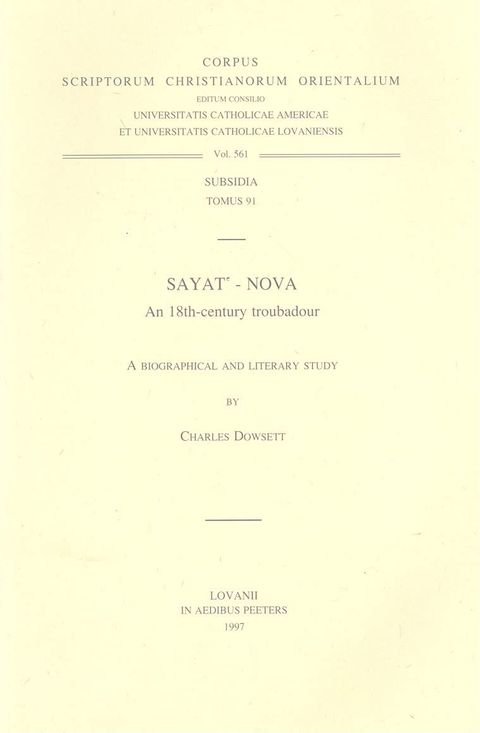
Sayat'-Nova, an 18th-Century Troubadour. a Biographical and Literary Study
SynopsisPlot
The most important of his songs in Armenian, Tiflis Armenian, Georgian and Azeri Turkish, one in four languages (these plus Persian), are edited in a unified transliteration from the original Georgian and Armenian scripts on the texts in the Tetrak, a 1765/6 MS in at least partly his own hand, and versions made in 1823 at St. Petersburg by his youngest son Ioane, with notes on variants, loanwords, cryptica ("trobar clus"), puns, etc. Six odes in poor Russian, hitherto ignored, are examined for motive and sentiments. Chapters are devoted to versification, genres and influences (mainly Persian), an attempt being made to analyse the attraction of his verse.
Story
About this book
Sayat'-Nova (roughly 1712 to 1795) was an Armenian poet and minstrel who composed songs in at least four languages: Armenian, Georgian, Azeri Turkish, and Persian. He spent much of his life in Tiflis, the city now called Tbilisi, which in his era was a multilingual crossroads of the South Caucasus. Charles Dowsett's study sets out to reconstruct both the biography and the literary world surrounding this figure, drawing on primary manuscript sources.
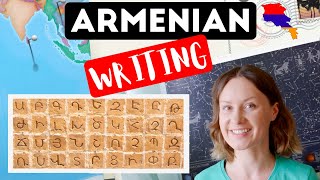
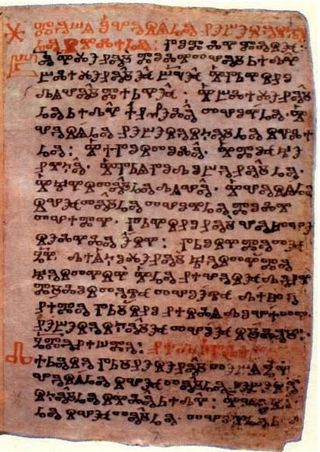
Central to the book is the Tetrak, a manuscript dated around 1765 or 1766 that appears to be at least partly in Sayat'-Nova's own handwriting. Dowsett also works with copies made in 1823 at St. Petersburg by the poet's youngest son, Ioane. The songs are presented in a unified transliteration from their original Georgian and Armenian scripts, accompanied by notes on variant readings, loanwords, wordplay, and instances of what medieval European tradition called trobar clus, meaning deliberately obscure or encoded poetic language.
Separate chapters address versification, genre, and the mainly Persian literary influences that shaped Sayat'-Nova's style. The study also examines six odes written in Russian, texts that earlier scholarship had largely overlooked, analyzing their possible motives and emotional content.