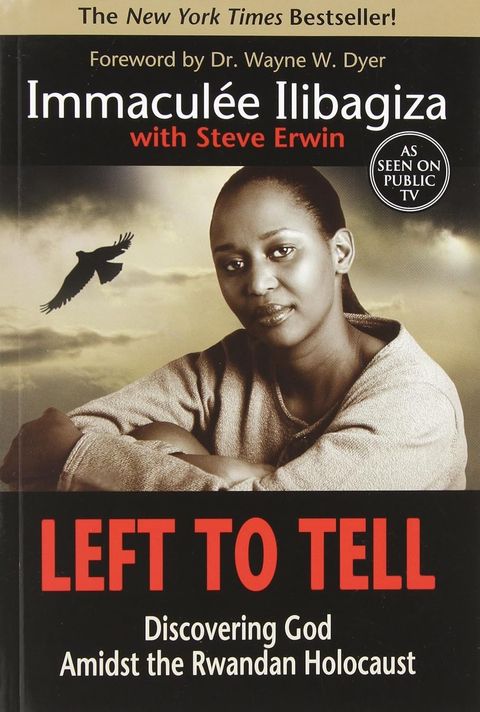
Left to Tell: Discovering God Amidst the Rwandan Holocaust
SynopsisPlot
Immaculee Ilibagiza grew up in a country she loved, surrounded by a family she cherished. But in 1994 her idyllic world was ripped apart as Rwanda descended into a bloody genocide. Immaculee’s family was brutally murdered during a killing spree that lasted three months and claimed the lives of nearly a million Rwandans. Incredibly, Immaculee survived the slaughter. For 91 days, she and seven other women huddled silently together in the cramped bathroom of a local pastor while hundreds of machete-wielding killers hunted for them. It was during those endless hours of unspeakable terror that Immaculee discovered the power of prayer, eventually shedding her fear of death and forging a profound and lasting relationship with God. She emerged from her bathroom hideout having discovered the meaning of truly unconditional love—a love so strong she was able seek out and forgive her family’s killers.
Story
About this book
In 1994, Rwanda descended into a genocide that killed nearly a million people, most of them Tutsi, in about three months. Immaculee Ilibagiza, a young Tutsi woman, lost most of her family. Her memoir, co-written with Steve Erwin, recounts how she survived by hiding for 91 days in a small bathroom belonging to a local pastor, together with seven other women. The space was so cramped that the women stayed nearly motionless and silent.
The book follows Ilibagiza from her childhood in a close family to the sudden collapse of ordinary life when the violence began. Much of the account centers on the weeks in hiding, where fear, hunger, and uncertainty shaped every hour. During that time she turned intensely to prayer, and the memoir traces how her faith changed in confinement.
After emerging from hiding, Ilibagiza eventually chose to confront and forgive those responsible for the deaths in her family. The book addresses that decision directly, placing it within her understanding of faith and unconditional love rather than treating it as an easy or expected step.