Weep Not, Refugee
SynopsisPlot
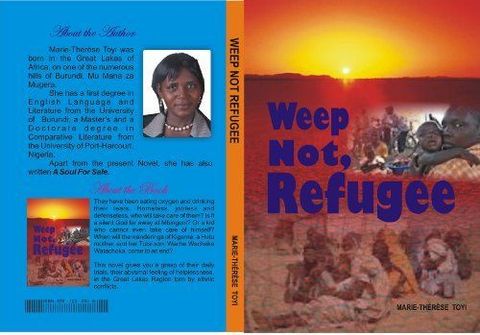
Kigeme, a Burundian secondary school girl, must flee to Wirodi for her safety, due to the outbreak of the Hutu- Tutsi war in Burundi. On her way to exile, she has her mother raped in the open and drowned in a river, her father chopped into pieces by enemies, and herself raped by a casual philanthropist in the name of Kiroro. The fruit of this rape is Wache Wacheke Watachoka, the protagonist of the novel. He will be born and raised in a refugee camp in Wirodi, in conditions of extreme poverty. But he will grow up. Her mother Kigeme will pass through a short time of prostitution to a lifetime profession (begging) in order to bring up Wache. Daily sufferings in the camp open his eyes to the true face of the world around him and give him the stamina to struggle for his own survival. He is very much aware that in Wirodi a refugee is highly unwanted.
Story
About this book
Weep Not, Refugee is a novel by Marie-Therese Toyi set against the backdrop of the Hutu-Tutsi conflict in Burundi. The story begins with Kigeme, a secondary school girl forced to flee to a place called Wirodi after violence erupts. During her flight, she witnesses and endures acts of extreme brutality, including the killing of both her parents and her own assault by a man called Kiroro, who poses as a benefactor.
The child born from that assault, Wache Wacheke Watachoka, becomes the central figure of the novel. He grows up in a refugee camp in Wirodi under harsh conditions. His mother Kigeme, left without resources or family, turns first to prostitution and then to begging as a long-term means of survival. The camp itself is a place of deprivation, and the surrounding society treats refugees with open hostility.
Through Wache's eyes, the novel traces what it means to grow up stateless, poor, and unwelcome. His daily experience in the camp sharpens his awareness of the barriers facing displaced people, and the story follows his efforts to find a foothold in a society that does not want him there. The title frames the novel's stance toward its subject from the outset.