Newcomers
SynopsisPlot
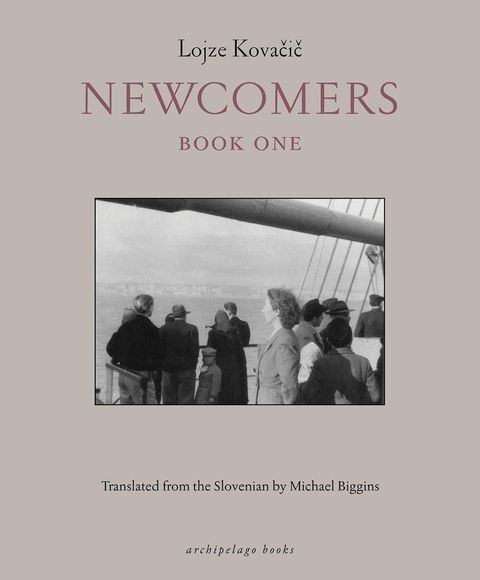
The first volume of this three-part autobiographical series begins in 1938 with the expulsion of the Kovacic family from their home of Switzerland, eventually leading to their settlement in the father's home country of Slovenia. Narrated by Kovacic as a ten-year-old boy, he describes his family's journey with uncanny naiveté. Before leaving their home, he imagines his father's home country as something beautiful out of a fairytale, but as they make their way toward exile, he and his family realize that any attempt to make a home in Slovenia will be in vain. Confronted by misery, hunger, and hostility, the young boy refuses to learn Slovenian and falls silent, his surroundings becoming a social, cultural and mental abyss.
Story
About this book
Newcomers is the first volume of a three-part autobiographical work by Slovenian writer Lojze Kovačič. It opens in 1938, when the Kovačič family is expelled from Switzerland and forced to relocate to the father's homeland of Slovenia. The narrator is Kovačič himself at the age of ten, and everything is filtered through that young view. Before the family leaves, the boy pictures Slovenia as a kind of fairytale country.
That fantasy collapses quickly. Once the family arrives, they face poverty, hunger, and open hostility from the people around them. The boy responds by refusing to learn Slovenian and withdrawing into silence. His world narrows as the gap between languages and cultures becomes something he cannot cross on his own. The writing moves between fragments of memory, some gentle and others harsh.
Kovačič's prose stays close to ordinary, physical details rather than abstract reflection. The child narrator reports displacement without fully understanding it, and the distance between what he notices and what he can explain shapes the book. Events of the late 1930s in Europe press on the family from outside, though the boy registers them mainly as changes in food, rooms, and voices.