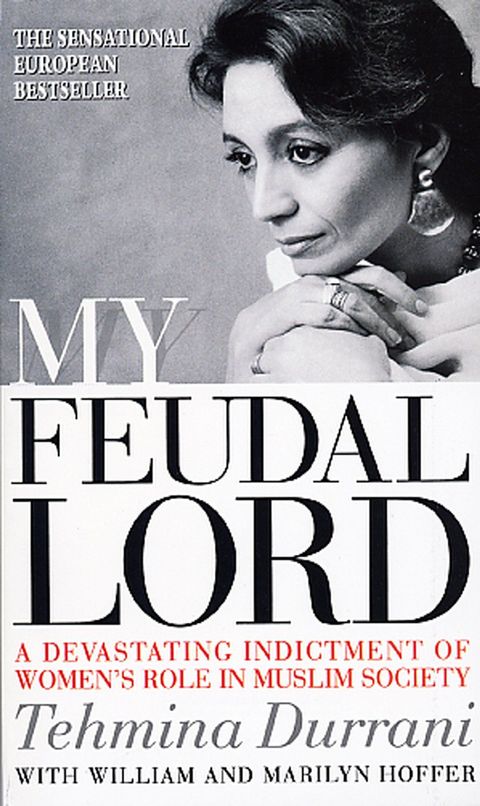
My Feudal Lord
SynopsisPlot
Born into one of Pakistan's most influential families, Tehmina Durrani was raised in the privileged milieu of Lahore high society and educated at the same school as Benazir Bhutto. Like all women of her rank, she was expected to marry a wealthy Muslim, bear him many children and lead a sheltered life of air-conditioned leisure. When she married Mustafa Khar, one of Pakistan's most eminent political figures, she continued to move in the best circles and learned to keep up the public facade as a glamorous, cultivated wife, and mother of four children. In private, however, the story-book romance rapidly turned sour. Mustafa Khar became violently possessive and jealous and succeeded in cutting his wife off from the outside world. For the course of her 14-year marriage, she suffered alone, in silence. This is the story of Tehmina's rebellion from an unhappy marriage. As a Muslim woman seeking a divorce, she paid a high price. She signed away all financial support, lost custody of her children, and found herself alienated from her friends and disowned by her parents.
Story
About this book
Tehmina Durrani grew up in one of Pakistan's most prominent families in Lahore, educated alongside future prime minister Benazir Bhutto. Her upbringing followed the expectations placed on women of her social position: marriage to a wealthy Muslim man, children, and a life conducted largely behind closed doors. When she married Mustafa Khar, a leading political figure, the outward appearance was one of glamour and influence. In private, Khar became violent, possessive, and controlling, gradually isolating her from family and the outside world. The marriage lasted fourteen years.
My Feudal Lord is Durrani's autobiography of that period and her eventual decision to seek divorce. As a Muslim woman leaving her husband, she faced severe consequences. She gave up all financial support, lost custody of her children, and was disowned by her own parents. The book examines the distance between public respectability and private suffering within elite Pakistani society, where social rank offered no protection from domestic abuse.
Durrani originally self-published the book after publishers in Pakistan refused to take it on. Its release caused significant controversy in the country, drawing attention to subjects that had been kept largely out of public discussion.