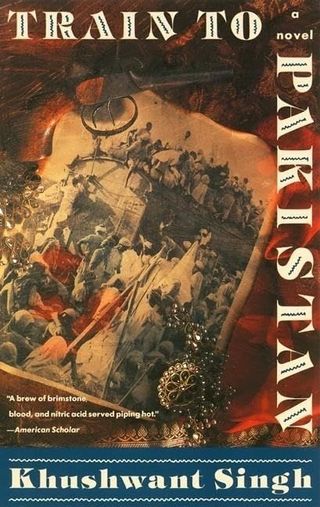
Train to Pakistan
SynopsisPlot
It is a place, Khushwant Singh goes on to tell us at the beginning of this classic novel, where Sikhs and Muslims have lived together in peace for hundreds of years. Then one day, at the end of the summer, the “ghost train” arrives, a silent, incredible funeral train loaded with the bodies of thousands of refugees, bringing the village its first taste of the horrors of the civil war.
Story
About this book
Khushwant Singh's novel is set in the summer of 1947, during the partition of British India into India and Pakistan. Millions of people, Hindu, Muslim, and Sikh, fled across the new borders. In the chaos that followed, mass violence swept through northern India. But in certain small, isolated villages along the frontier, communities that had lived side by side for generations remained, for a time, untouched.
Mano Majra is one such village, a place where Sikhs and Muslims share daily life and have done so for centuries. The story begins when a train pulls into the local station carrying the bodies of dead refugees. This single event cracks the fragile calm, and the villagers find themselves drawn into the sectarian hatred spreading across the subcontinent. Against this backdrop, Singh follows the relationship between a young Sikh man and a Muslim woman, testing whether personal bonds can hold when an entire region is fracturing along religious lines.
The novel also introduces figures from outside the village, including a political worker and a local magistrate, whose motives and methods complicate the situation further. Singh wrote from direct experience of partition-era Punjab, and the book was first published in 1956.