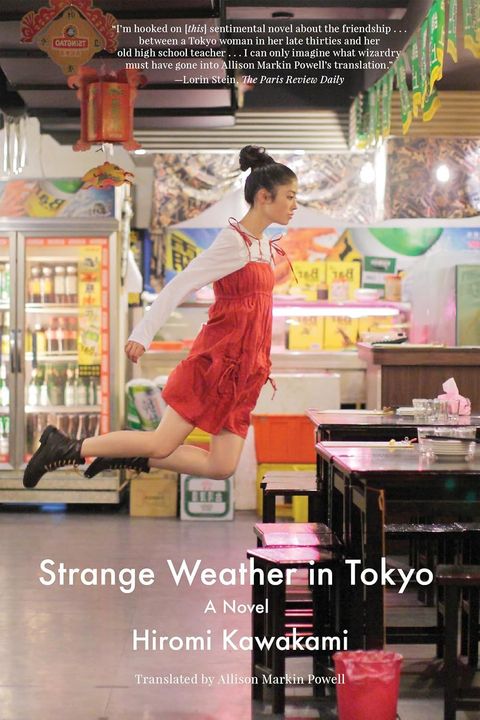
Strange Weather in Tokyo
SynopsisPlot
Tsukiko, thirty-eight, works in an office and lives alone. One night, she happens to meet one of her former high school teachers, "Sensei," in a local bar. Tsukiko had only ever called him "Sensei" ("Teacher"). He is thirty years her senior, retired, and presumably a widower. Their relationship develops from a perfunctory acknowledgment of each other as they eat and drink alone at the bar, to a hesitant intimacy which tilts awkwardly and poignantly into love.
Story
About this book
Tsukiko is thirty-eight, single, and works in an office in Tokyo. One evening she recognizes a man sitting alone at a neighborhood bar: her former high school teacher, whose real name she never uses. She calls him only Sensei, as she did years ago in class. He is now retired, about thirty years older than her, and apparently a widower. At first they barely speak, each comfortable enough in solitary drinking not to need conversation. Over time, a loose routine forms between them.
Their connection builds through small, concrete shared moments: meals at the bar, walks through the city, day trips to collect mushrooms or visit a flea market. Kawakami tracks these encounters against the turning seasons, marking time through what the two characters eat and drink together, from warm sake in winter to cold beer in summer, from bare branches to cherry blossoms. The seasonal rhythm gives the story a quiet structure and underlines how slowly and unevenly closeness can develop between two guarded people.
The novel was originally published in Japanese in 2001 and was shortlisted for the 2013 Man Asian Literary Prize. Its central subject is the gap between solitude and companionship, and the particular awkwardness that arises when affection crosses a wide difference in age and temperament.