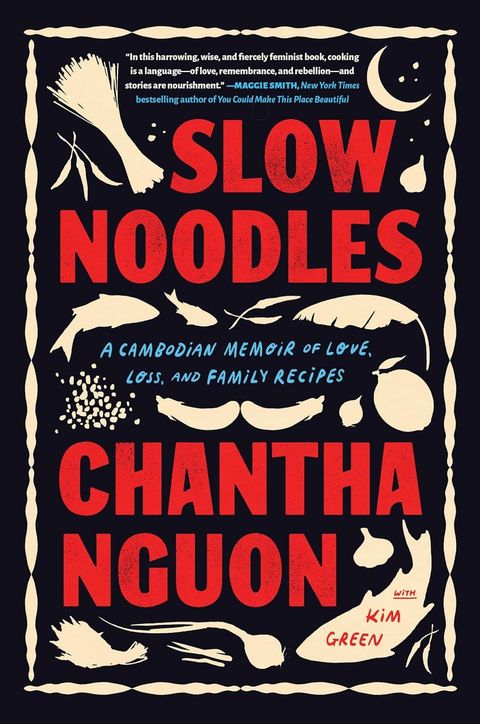
Slow Noodles: A Cambodian Memoir of Love, Loss, and Family Recipes
SynopsisPlot
In Slow Noodles, Chantha Nguon recounts her life as a Cambodian refugee who loses everything and everyone—her home, her family, her country—all but the remembered tastes and aromas of her mother’s kitchen. She summons the quiet rhythms of 1960s Battambang, her provincial hometown, before the dictator Pol Pot tore her country apart and killed more than a million Cambodians, many of them ethnic Vietnamese like Nguon and her family. Then, as an immigrant in Saigon, Nguon loses her mother, brothers, and sister and eventually flees to a refugee camp in Thailand. For two decades in exile, she survives by cooking in a brothel, serving drinks in a nightclub, making and selling street food, becoming a suture nurse, and weaving silk.
Story
About this book
Chantha Nguon grew up in Battambang, a provincial city in western Cambodia, during the 1960s. Her childhood was shaped by the sounds and smells of her mother's kitchen, where food carried the rhythms of daily family life. That world ended when the Khmer Rouge, led by the dictator Pol Pot, dismantled Cambodian society and killed over a million people. Nguon and her family, ethnic Vietnamese Cambodians, were among those directly targeted.
Slow Noodles follows Nguon through decades of displacement. After losing her mother, brothers, and sister while living as an immigrant in Saigon, she eventually reached a refugee camp in Thailand. Over the years she worked in a wide range of settings, cooking in a brothel, serving drinks in a nightclub, selling street food, training as a suture nurse, and weaving silk. Throughout these shifts, the remembered flavors of her mother's cooking remained a persistent thread connecting her to her earlier life in Battambang.
The memoir pairs Nguon's personal account with family recipes, using food as a concrete record of what survived when nearly everything else was lost. The book traces how specific dishes carried meaning across borders, camps, and years of exile.