Year of the Rabbit
SynopsisPlot
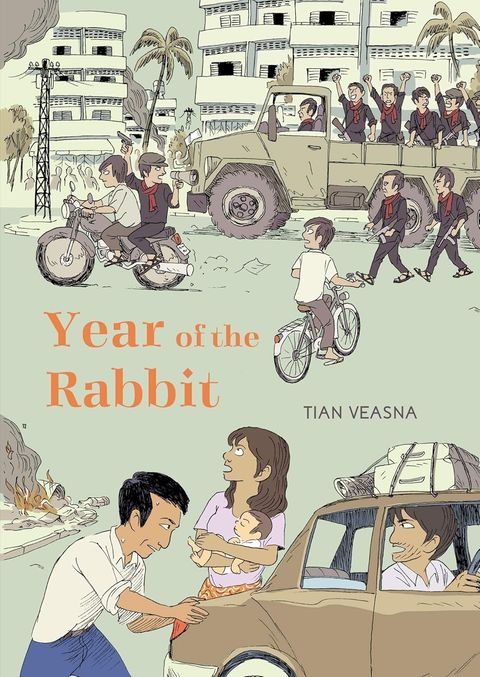
Year of the Rabbit tells the true story of one family’s desperate struggle to survive the murderous reign of the Khmer Rouge in Cambodia. In 1975, the Khmer Rouge seized power in the capital city of Phnom Penh. Immediately after declaring victory in the war, they set about evacuating the country’s major cities with the brutal ruthlessness and disregard for humanity that characterized the regime ultimately responsible for the deaths of one million citizens. Cartoonist Tian Veasna was born just three days after the Khmer Rouge takeover, as his family set forth on the chaotic mass exodus from Phnom Penh. Year of the Rabbit is based on firsthand accounts, all told from the perspective of his parents and other close relatives. Stripped of any money or material possessions, Veasna’s family found themselves exiled to the barren countryside along with thousands of others, where food was scarce and brutal violence a constant threat.
Story
About this book
In April 1975, the Khmer Rouge took control of Phnom Penh and immediately began forcing residents out of the capital and other major cities. Tian Veasna was born just three days into this upheaval, as his family joined the mass displacement from the city into the countryside. Year of the Rabbit is a graphic memoir drawn from the firsthand accounts of his parents and close relatives, tracing their experience under the regime that governed Cambodia until 1979 and caused the deaths of roughly one million people.
Stripped of money and possessions, the family was sent to rural work camps where food was scarce and violence was routine. The book depicts the everyday conditions of survival under the regime: bartering for basic goods, children encouraged to report on their own parents, and the act of reading treated as evidence of disloyalty to the state. Veasna reconstructs these details through his relatives' memories, presenting the period at close range rather than from a historical overview.
The story follows the family's efforts to endure forced labor, hunger, and constant surveillance. As a work of graphic nonfiction, it uses sequential art to convey both the scale of the evacuations and the confined, precarious reality inside the camps.