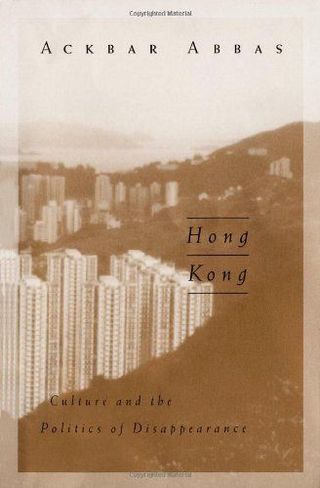
Hong Kong: Culture and the Politics of Disappearance
SynopsisPlot
On June 30, 1997, Hong Kong as we know it will disappear, ceasing its singular and ambiguous existence as a colonial holdover and becoming part of the People’s Republic of China. In an intriguing and provocative exploration of its cinema, architecture, photography, and literature, Ackbar Abbas considers what Hong Kong, with its unique relations to decolonization and disappearance, can teach us about the future of both the colonial city and the global city. The culture of Hong Kong encompasses Jackie Chan and John Woo, British colonial architecture and postmodern skyscrapers. Ironically, it was not until they were faced with the imposition of Mainland power—with the signing of the Sino-British Joint Agreement in 1984—that the denizens of the colony began the search for a Hong Kong identity. According to Abbas, Hong Kong’s peculiar lack of identity is due to its status as “not so much a place as a space of transit,” whose residents think of themselves as transients and migrants on their way from China to somewhere else.
Story
About this book
Ackbar Abbas wrote this study of Hong Kong culture in the years before the 1997 handover, when the territory was to pass from British colonial rule to the People's Republic of China. He examines cinema, architecture, photography, and literature, arguing that Hong Kong long worked less as a rooted place than as a point of transit, its residents thinking of themselves as migrants between China and elsewhere.
The book traces a shift that began after the 1984 Sino-British Joint Declaration, the agreement that set the terms of the handover. Abbas argues that the prospect of mainland authority prompted an urgent search for a distinct Hong Kong identity that had not felt necessary before. He links this to a politics of disappearance, in which the city's culture became visible as its familiar status was ending.
His examples range from action filmmakers such as Jackie Chan and John Woo to the contrast between colonial-era buildings and the postmodern towers of the skyline. Abbas treats the city as a case that raises wider questions about the futures of colonial cities and global cities.