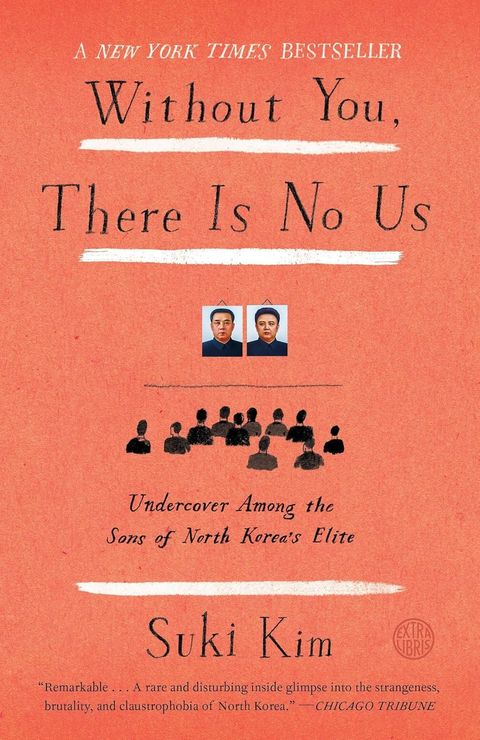
Without You, There Is No Us: Undercover Among the Sons of North Korea's Elite
SynopsisPlot
Every day, three times a day, the students march in two straight lines, singing praises to Kim Jong-il and North Korea: Without you, there is no motherland. Without you, there is no us. It is a chilling scene, but gradually Suki Kim, too, learns the tune and, without noticing, begins to hum it. It is 2011, and all universities in North Korea have been shut down for an entire year, the students sent to construction fields—except for the 270 students at the all-male Pyongyang University of Science and Technology (PUST), a walled compound where portraits of Kim Il-sung and Kim Jong-il look on impassively from the walls of every room, and where Suki has gone undercover as a missionary and a teacher. Over the next six months, she will eat three meals a day with her young charges and struggle to teach them English, all under the watchful eye of the regime.
Story
About this book
In 2011, Suki Kim entered North Korea posing as a Christian missionary and English teacher at the Pyongyang University of Science and Technology, known as PUST. The walled compound in the capital held around 270 young men from elite families. That year every other university was closed and its students sent to construction sites. Portraits of Kim Il-sung and Kim Jong-il hung in every room.
Kim spent six months inside the compound, eating three meals a day with her students and working to teach them English under constant official supervision. Her position gave her sustained contact with young North Koreans raised at the highest levels of the state. She recorded how they spoke, what they believed about the outside world, and what stayed hidden from them.
The account covers the last six months of Kim Jong-il's rule, which ended with his death in December 2011. It sits between memoir and undercover reporting, and its central strain comes from Kim's need to conceal her purpose from the institution and the authorities while growing attached to the students she taught. The marching song that gives the book its title was sung three times a day.