Throwim' Way Leg
SynopsisPlot
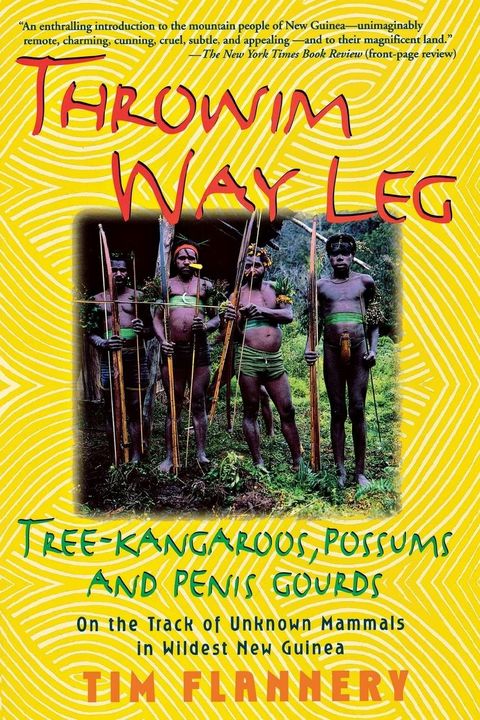
Flannery travels to the unexplored regions of New Guinea in search of species that science has yet to discover or classify. He finds many -- from a community of giant cave bats that were supposedly extinct to the elusive black-and-white tree kangaroo -- and along the way has a wealth of unforgettable adventures. Flannery scales cliffs, descends into caverns, and cheats death, both from disease and at the hands of the local cannibals, who wish to take revenge on his "clan" of wildlife scientists. He eventually befriends the tribespeople, who become companions in his quest and whose contributions to his research prove invaluable. In New Guinea pidgin, throwim way leg means to take the first step of a long journey.
Story
About this book
Tim Flannery, an Australian mammalogist, spent years conducting fieldwork in the remote interior of New Guinea, searching for animal species unknown or poorly documented by Western science. In the Tok Pisin language widely spoken across Papua New Guinea, the phrase throwim way leg means to take the first step of a long journey. Flannery's expeditions carried him into caves, up cliff faces, and through dense highland forests in pursuit of creatures such as giant bats believed to be extinct and the rarely observed black-and-white tree kangaroo.
The book records both the biological fieldwork and the human encounters that shaped it. Flannery describes early tensions with local communities, including groups whose traditions included cannibalism and who initially regarded his team of wildlife researchers with hostility. Over time, these relationships shifted. Tribespeople became collaborators in the search for specimens and shared ecological knowledge that proved essential to his findings.
New Guinea is the world's second-largest island and one of the most biologically diverse land masses on Earth. Much of its mountainous interior remained difficult for outside researchers to reach well into the late twentieth century. Flannery's account sits at the intersection of natural history, anthropology, and travel writing, grounded in specific species discoveries and the logistics of working in terrain with few roads and limited infrastructure.